















新闻动态
清医育人丨John Spivey—a great clinical teacher, remembered by Prof. Daniel Edward Porter
编者按
值此教师节,英国爱丁堡皇家外科学院院士、清华大学医学院教授、清华一附院骨科医学中心Daniel Edward Porter教授深情追忆其临床导师John Spivey先生,诠释了医者薪火相传的珍贵意义。在严格的临床培养环境中,John Spivey先生秉持耐心与信任,将繁复的骨科知识、手术技法化繁为简。他不仅授人以术,更传授坦诚行医、平衡职业与生活的从业真谛。亦师亦友的温情、润物无声的育人理念,跨越山海与岁月,成为医者坚守初心、砥砺前行的珍贵力量。
On the occasion of Teachers’ Day, Professor Daniel Edward Porter—Fellow of the Royal College of Surgeons of Edinburgh, Professor at the School of Clinical Medicine, Tsinghua University, and core member of the Orthopedic Medical Center at the First Hospital of Tsinghua University - pays tribute to his clinical mentor, Mr. John Spivey. His account captures the enduring value of mentorship in medicine. In a tough training environment, Mr. Spivey taught with patience and trust, breaking down complex orthopaedics into clear principles. He imparted not just surgical skills, but also integrity and the art of balancing work with life. The warmth of a teacher who was also a friend, and a philosophy that nurtures quietly, transcend time and place—offering a lasting source of strength for every clinician committed to their calling.

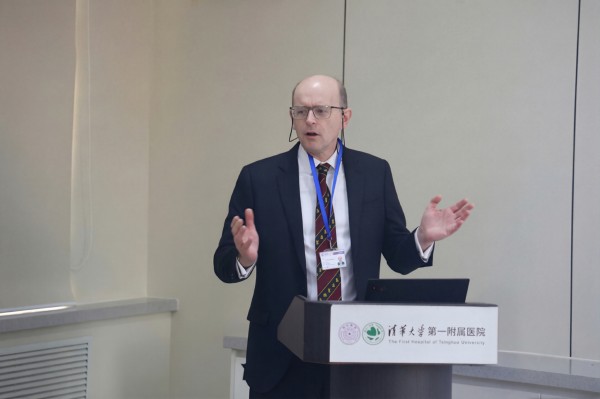
Professor Daniel Edward Porter
On this Teachers Day I would like to recall the influence of one of my own clinical teachers, John Spivey.
In the United Kingdom it is conventional for doctors who gain the surgical qualification MRCS or FRCS to revert to the title ‘Mr’. Mr. John Spivey was an orthopaedic surgeon in Oxford.
I can call John Spivey by his Christian name ‘John’ as he is not only my teacher, but also a friend.
John didn’t go out of his way to teach, however his straightforward manner and method was important in helping me to see that orthopaedic surgery did not have to be difficult and complicated. Since clinical practice brings many stresses and challenges, he showed me that simplicity in the understanding of diseases, in the doctor-patient relationship, in operative techniques and in work-life balance is important for resilience and long-term happiness.
For the majority of my internship and junior resident training I genuinely didn’t look forward to going to work. The reason? Uncertainty and lack of confidence. Medical school really didn’t equip me with the skills needed to cope well with daily clinical practice. As a junior doctor I was expected to manage complex emergencies in general surgery and then in orthopaedic trauma seemingly with little senior help and for very long periods of duty. Working from Friday morning to Monday evening was a normal occurrence every second or third weekend. Sleep could only be caught at brief intervals overnight.
At the time, this was seen as the most suitable way to learn to be a doctor. Similar to the technique of throwing a child into deep water to learn to swim, ‘necessity becomes the mother of invention’, as the idiom goes. By forcing responsibility without experience onto very junior staff we had to learn quickly. Gradually our abilities improved. We tried to avoid errors by reading, watching, copying…but it was an unwritten rule that senior doctors should only be contacted for help in extreme circumstances. This cultural expectation was part of the so-called ‘hidden curriculum’. It disadvantaged individual patients, but as a group patients benefitted from efficient, if sometimes sub-optimal care…since in those days operating lists were long and waiting lists were short.
As for myself, I seriously considered giving up clinical medicine at that time to retrain in Agricultural College.
Within this culture John Spivey seemed to recognise that his junior doctors were human beings who needed to learn how orthopaedic surgery could become satisfying. He was an established senior doctor and Director of the Department in Oxford’s Nuffield Orthopaedic Centre. He had been raised in a north Lancashire family in which his father had been a local government town architect. Understanding principles of engineering construction led John naturally to orthopaedics at a time when joint replacement was becoming a practical reality and the technology of implant development was rapid. He worked at Wrightington Hospital near Manchester, in which Sir John Charley had designed the first effective hip replacement during the 1960s. He moved to Oxford in the 1970s talking on the role of arthroplasty and bone tumour surgeon.
I was appointed by Oxford University as one of three clinical lecturers and honorary Registrar (the name once given to senior Residents in the UK) in orthopaedics in 1995. After six months I joined John’s firm as his Registrar. At the time I had no ability to perform hip and knee replacements independently.
John patiently taught us the basics of pathology…how arthritis is classified in all its types.…tumour classification and their characteristics…..how to identify patients with classic symptoms and classic x-ray appearances. Every lesson was based on easily understood principles. For example, traditional teaching held that secondary osteoarthritis should be classified according to standardised causes such as iatrogenic, vascular, inflammatory, traumatic, autoimmune, metabolic, infective, neoplastic and genetic. Now John simplified the system into three direct abnormalities-abnormal bone, abnormal cartilage, abnormal forces. All other aetiologies could be found in these three classes.
He delivered surgical training in the same way. An ultimately complex operation could be broken down into stages-pre-operative patient preparation, positioning, incision, approach, exposure, joint preparation. implant positioning and fixation, closure, post-operative care. He let me do the easy parts first, then later the more technically demanding elements. Finally came the synthesis of all components. Gradually I took on more responsibility. I would come into the hospital on my weekends off to help him operate. Within six months he was giving me complete operation lists when he was away, although a more senior surgeon would be available nearby in case of unexpected events.
He showed me how to do hip replacements without any assistance; only the scrub nurse occasionally providing help. I did make mistakes of course, but he never once showed that he had lost confidence in me.
We had clinics in Oxford and in Newbury which is a town 50 kilometers south of Oxford. In Newbury we would work in different clinic rooms joined by an office so that I could ask John questions about our patients and their problems. He would often give his Registrars a lift down to the clinic where we would talk about the importance of keeping friendships in medicine. Many orthopaedic Fellows and PhD students from all over the world worked in Oxford in those days. After they left they developed the habit of meeting annually for a scientific conference organised by an older colleague somewhere in the world. This group still meets annually, and those of us who worked for a while in Oxford generally try to attend and enjoy each other’s company for one week together. It is called the Girdlestone Orthopaedic Club, named after the first professor of Orthopaedics in Oxford.
In Newbury John and I would see patients with every common orthopaedic condition. He showed me rapid and practical methods for diagnosis and simple management plans. He had a remarkable ability to identify patients with psychological reasons for their pain, and therefore those who would not do well after surgery.
When I sat my FRCS examination in Scotland four years later, John had already retired to the English Lake District. His home was just off the motorway between Oxford and Glasgow. After the examination had finished I stayed with him overnight on the way back down to Oxford. He was a keen sailor and when he retired he bought a yacht for sailing on the lakes. He was kind enough to invite his Registrars to join him on holidays. We enjoyed yacht racing and the camaraderie built on past shared endeavour and easy friendship.
Eventually I left Oxford to take the post of Senior Lecturer in Orthopaedics at Edinburgh University and then a professorship at Tsinghua University, however the lessons John taught never left me. He was the first to teach me how to do a hip replacement and a knee replacement. I still use many of the techniques he showed me thirty years ago.
It’s difficult to define what made John a good teacher. Of course, this must include an openness and willingness to pass-on what he had learned himself during a lifetime of experience.
It’s not necessary to demonstrate special knowledge or skills to be a good teacher. Many students struggle with both understanding and memorisation. Simplicity solves both problems.
Neither is it necessary to take time out from clinical practice to teach. Training can be done easily in the clinic or operating room. Only a little patience and trust is required.
Mr. John Spivey is one of my great clinical teachers, although he probably doesn’t realise it.


 京公网安备 11010502041988号